07 May 2026
How to Benchmark Your Brand Across ChatGPT, Perplexity, and Google AI Overviews

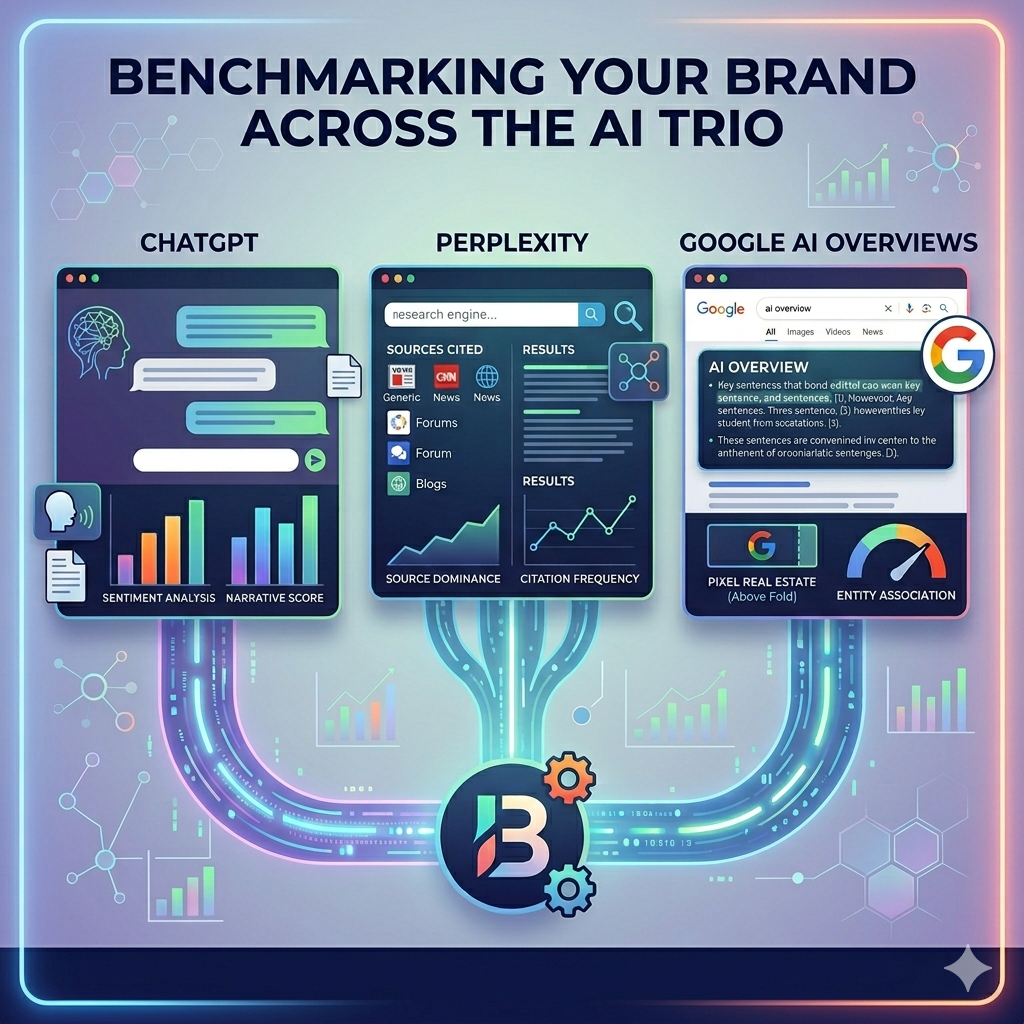
The digital marketing landscape is undergoing its most seismic shift since the invention of the PageRank algorithm. We have officially entered the era of AIO (AI Optimization) and GEO (Generative Engine Optimization).
For enterprise brands, the stakes are incredibly high. It is no longer enough to rank blue links on the first page of Google. Today, consumers are asking complex questions directly to AI agents. If your brand is not being cited, recommended, or surfaced in these AI-generated responses, you are effectively invisible to a massive and growing segment of the market.
How to Audit Your Enterprise Brand’s AI Search Visibility
Auditing your visibility in the age of AI requires a departure from traditional SEO metrics like “Keyword Difficulty” or “Domain Authority.” Instead, you must focus on Brand Share of Model (BSoM). A metric that measures how often and how favorably your brand appears in AI responses relative to your competitors.
Recent studies highlight the urgency of this transition:
- Adoption Rates: Over 80% of Fortune 500 companies have registered ChatGPT Enterprise accounts.
- Search Volume: Perplexity AI recently reported processing over 230 million queries per month, doubling its volume in less than half a year.
- User Trust: According to Prabhakar Raghavan, a Senior Vice President at Google, during the Fortune Brainstorm Tech conference, 40% of Gen Z users prefer using TikTok or AI-driven interfaces over traditional Google Search for discovery.
- Impact of AIOs: Google’s AI Overviews (SGE) appear for roughly 15-25% of queries, often pushing organic results deep below the fold.
To stay ahead, you need a systematic way to benchmark your presence. We have discussed in-depth about how to audit your enterprise’s brand AI Search Visibility in this article. This guide will walk you through the technical and strategic steps to audit and benchmark your brand across the Big Three of the AI era: ChatGPT, Perplexity, and Google AI Overviews.
Step 1: Defining Your AI Benchmark Keywords
Before you start prompting, you must categorize your AI Search Intent. Traditional SEO focuses on high-volume keywords; AI benchmarking focuses on consultative queries.
AI Search Intent is the evolution of traditional search intent. While classic SEO focuses o what a user is looking for (Information, Navigation, Transaction), AI Search Intent focuses on the complexity of the conversation and the desire for a synthesized answer.
In the world of ChatGPT, Perplexity, and Google AI Overviews, users aren’t just looking for a list of websites; they are looking for a reasoned conclusion.
Divide your audit into three buckets:
- Direct Brand Queries: “What is [Brand Name] known for?”
- Comparative Queries: “What is the difference between [Brand Name] and [Competitor]?”
- Category Need Queries: “What is the best enterprise solution for [Problem Your Brand Solves]?”
To gain a deeper understanding of how these queries are processed by different LLMs, you can explore the frameworks provided here, which focus on how these AI search engines decide what to cite.
Step 2: Benchmarking ChatGPT
ChatGPT is often referred to as a Knowledge Model because it is designed to prioritize internal reasoning and synthesis over raw data retrieval.
Unlike an “Answer Engine” (like Perplexity) or a “Search Engine” (like Google), which prioritize finding and displaying external links, ChatGPT focuses on the relationships between concepts stored within its massive neural network.
ChatGPT (specifically GPT-4o) relies heavily on its training data and its “Browse with Bing” capability. Benchmarking here is about understanding your brand’s Sentiment and Narrative.
The Methodology:
- The Narrative Test: Prompt: “Summarize the current market reputation of [Your Brand] based on online reviews and news from the last 12 months.”
- The Recommendation Engine: Prompt: “I need a solution for [Industry Problem]. Which companies should I consider and why?”
Key Metric to Track:
Citations and Verifiability. ChatGPT now includes citations. Check if the “sources” it cites are your own website or third-party review sites. If ChatGPT is citing your competitors’ blogs to explain your industry, you have a content gap.
Step 3: Benchmarking Perplexity AI (The Search Companion)
Perplexity is a Generative Answer Engine. It is more transactional and research-oriented than ChatGPT. It pulls live data from the web for almost every query. Perplexity AI has earned the title of the Search Companion because it is built to be a high-speed, transparent partner in the act of discovery.
The Methodology:
- Source Mapping: Run a query for your top 10 industry keywords. Look at the “Sources” row at the top.
- The “Pro” Search Audit: Use Perplexity Pro to see how it “thinks.” It will show you the intermediate search steps it takes to find an answer.
Key Metric to Track:
Source Dominance. If Perplexity is citing Reddit, G2, or Wikipedia instead of your primary domain, your brand is losing control of its own story. You must ensure your technical SEO allows Perplexity’s bot to crawl and index your most authoritative pages.
Step 4: Benchmarking Google AI Overviews
Google AI Overviews (AIO) are different because they are tethered to the world’s largest search index. Google prioritizes “Information Gain”, content that adds something new to the web rather than just repeating it. It is known as the Ecosystem Giant. This reflects its unique ability to leverage its massive, interconnected infrastructure spanning search, shopping, maps, and advertising to dominate the user’s journey from discovery to action.
The Methodology:
- The “Above the Fold” Test: Check how many of your ranking keywords now trigger an AI Overview.
- The Entity Association Test: Use a tool or manual search to see which “entities” (related brands, people, or concepts) Google links to your brand within the AIO box.
Key Metric to Track:
Pixel Real Estate. Measure how much the AIO pushes your organic #1 result down the page. If the AIO provides a full answer and a link to a competitor, your organic traffic for that keyword is at high risk.
Step 5: Scoring Your AI Visibility
To create a benchmark that you can report to stakeholders, use a 1–5 scoring system for each platform based on the following criteria:
| Criteria | Score 1 (Invisible) | Score 3 (Present) | Score 5 (Dominant) |
| Brand Accuracy | Brand is mischaracterized. | Basic facts are correct. | Detailed, nuanced, and positive. |
| Citation Frequency | Zero links to your site. | 1-2 links in the footer. | Multiple citations in the body. |
| Competitive Rank | Competitors are listed first. | You are listed among 5 others. | You are the primary recommendation. |
Step 6: Optimizing Based on Benchmark Data
Once you have audited your visibility, you must move into the optimization phase. This is where GEO comes into play.
1. Address the Knowledge Gap
If AI models are hallucinating facts about your brand, it’s usually because your structured data is weak. Implement Schema Markup (Organization, Product, and FAQ schema) rigorously. This provides a “source of truth” that AI scrapers can easily digest.
2. Focus on Brand Mentions Over Backlinks
In the AI era, a mention of your brand on a high-authority site (like a Forbes interview or a specialized industry journal) is often more valuable than a backlink. AI models look for “Co-occurrence”. The frequency with which your brand name appears near relevant industry keywords.
3. Create Information-Rich Content
AI Overviews favor content that uses clear headings, bullet points, and authoritative data. Instead of writing 2,000-word fluff pieces, create data-heavy reports. AI models love citing original statistics and unique insights.
Step 7: Continuous Monitoring
AI models are not static; they are updated and fine-tuned constantly. A benchmark taken today may be obsolete in three months.
- Monthly AI Audits: Perform the same set of 20 prompts across all three platforms every 30 days.
- Monitor “Shadow” Competitors: In AI search, your competitors might not be the companies you sell against. They might be information sites like Wikipedia or Forbes that steal the citation for your industry’s core concepts.
Conclusion
Benchmarking your brand across ChatGPT, Perplexity, and Google AI Overviews is no longer an optional innovation project. It is a core requirement for enterprise survival. The brands that win in 2026 and beyond will be those that treat AI agents as their most important customer.
By systematically auditing your visibility and closing the gaps in your digital presence, you ensure that when a potential client asks an AI for a recommendation, your brand is the one that comes to mind.
Storyteller



Other posts
-



Swetha Sree Kannan
- 21 Oct 2026
- 4 min read
-

Swetha Sree Kannan
- 21 Oct 2026
- 5 min read
-


Sunil Kolakunnath
- 29 Sep 2026
- 4 min read