
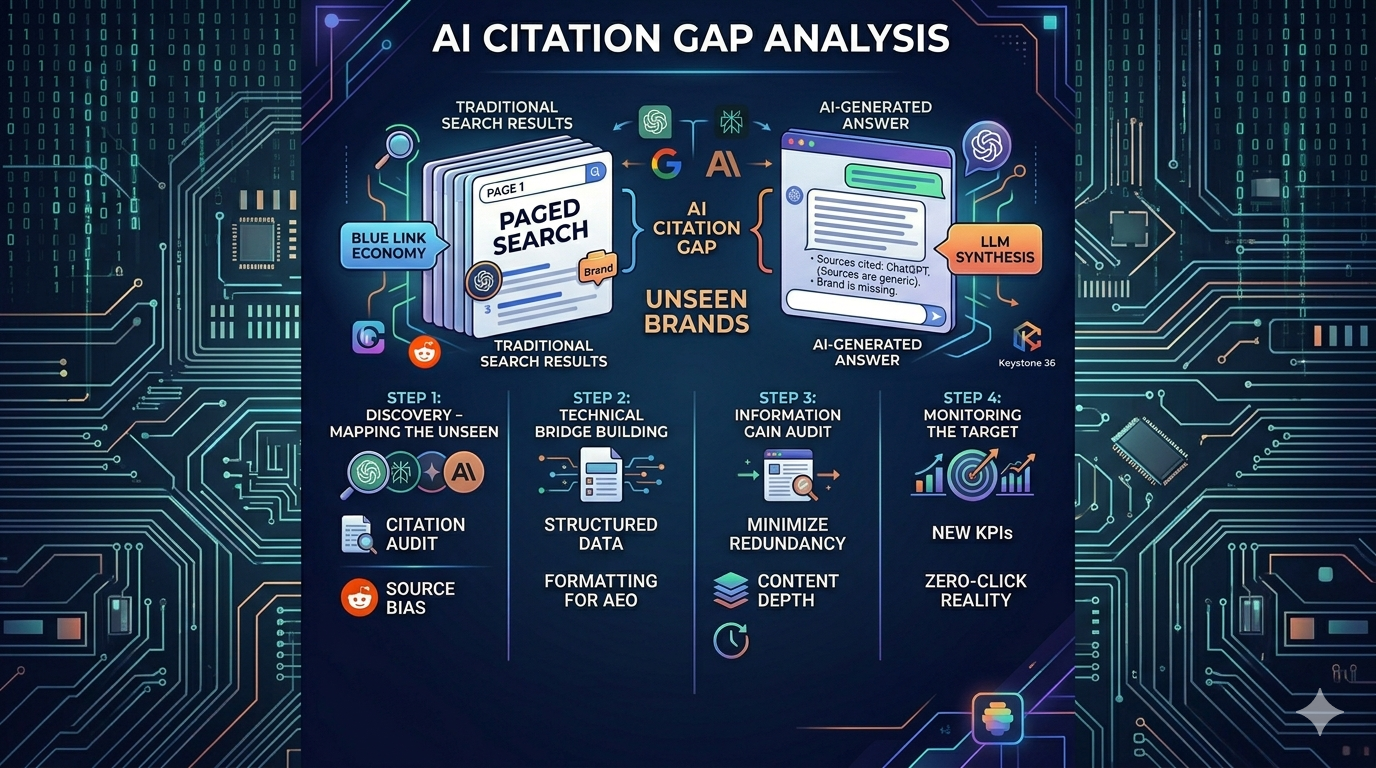
For decades, brands obsessed over the blue link economy – securing a spot on the first page of Google. However, as users increasingly turn to Large Language Models (LLMs) like ChatGPT, Claude, and Gemini, as well as answer engines like Perplexity, the battleground has moved from search results to latent space.
Recent market shifts underscore the urgency: Gartner predicts that traditional search engine volume will drop by 25% by the end of 2026 as users migrate toward AI-powered virtual agents. When an AI provides a synthesized verdict, being the 11th link is no longer a low ranking. It is functional invisibility.
The AI Citation Gap refers to the discrepancy between a brand’s traditional search engine visibility and its presence in AI-generated answers.
Essentially, it is a situation where your brand ranks well on a standard Search Engine Results Page but is ignored by AI engines (like Perplexity, ChatGPT, or Google’s AI Overviews) in favor of competitors when answering the same query.
This is the AI Citation Gap, and closing it is the next frontier of digital strategy. Earlier we have discussed in depth How to Audit your Enterprise Brand’s AI Search Visibility in our pillar blog.
The Anatomy of the AI Citation Gap
The AI Citation Gap is the delta between your brand’s actual market authority and its perceived authority within an AI’s training data and real-time retrieval context. Unlike traditional SEO, where visibility is earned through keywords and backlinks, AI visibility is earned through contextual associations and information gain.
A gap exists when your brand has high SEO authority but zero citation share. To understand how these systems decide what to include, brands must look beyond keywords toward how AI engines like ChatGPT and Gemini decide what to cite.
A citation gap typically occurs because:
- Structure over Keywords: AI models prefer content that is synthesis-ready. That is content broken down into clear definitions, bullet points, and modular data that is easy for a machine to quote.
- Authority Signals: AI engines often pull from a shortlist of trusted domains. Even if your content is better, if the AI does not recognize your brand as a topical authority or “entity,” it will cite a competitor with stronger industry mentions.
- The Fluff Factor: Traditional SEO content often buries the lead to satisfy word-count norms. AI models look for the most direct, evidence-backed answer first; if your content is too narrative, it gets skipped.
Step 1: Mapping the Unseen – The Discovery Phase
Before you can fix the gap, you must find it. Standard SEO tools are insufficient because they measure traffic, not synthesis probability. You need to understand how often your brand is part of the “Consideration Set” of the model.
The Citation Share Audit
Start by identifying 50–100 keystone queries that represent your core business.
- Methodology: Run these queries through ChatGPT with Search, Perplexity, Gemini, and Claude.
- Metric: Calculate your Citation Share. Currently, the top five domains in any given niche capture 38% of all AI citations, while the top 20 command 66%.
Identifying Source Bias
AIs often have favored sources. For instance, Wikipedia accounts for 7.8% of citations in ChatGPT, followed by platforms like Reddit (1.8%) and Forbes (1.1%). This creates a Platform Paradox: you may have a world-class blog, but if the AI prefers citing Reddit threads for “authentic” reviews, your absence from those discussions creates a Channel Gap that no amount of SEO can bridge.
Step 2: Technical Bridge Building (GEO & AEO)
If your brand is invisible, it may be because the AI cannot parse your authority. This is often caused by a lack of clarity between different optimization types. To master this, you must understand the core differences between SEO, GEO, and AEO, as each serves a different stage of the user’s journey.
Structured Data and Formatting
AIs favor certainty. By using advanced Schema.org markup, you provide a blueprint for the model.
- The AEO Advantage: Answer Engine Optimization (AEO) ensures that your brand’s information is presented as the definitive answer to a user’s query.
- Formatting for LLMs: LLMs are 28% to 40% more likely to cite content that uses clear hierarchical headings, bullet points, and tables.
Step 3: The Information Gain Audit
AI models are designed to minimize redundancy. If your website merely repeats industry tropes, an AI has no reason to cite you. This leads to content invisibility.
The Taste Gap vs. AI Slop
The rise of AI slop: generic, high-volume content, has made LLMs more selective. To close the gap, your content must deliver meaningful information gain.
- Depth matters: Research shows that articles over 2,900 words are 59% more likely to be cited by ChatGPT than those under 800 words.
- Recency is vital: Content updated within the past three months is twice as likely to be cited as older, outdated pages.
Step 4: Monitoring the Moving Target
AI visibility is not a one-time project. It requires a new set of KPIs focused on the quality of interaction rather than sheer volume.
The New Conversion Reality
While AI-driven traffic volume is currently smaller than Google’s, the quality is often higher due to the pre-validation provided by AI summaries.
- Higher intent: Visitors referred by AI convert at an average rate of 14.2%, compared to 2.8% for traditional Google traffic.
- Zero-click reality: AI Overviews have been shown to reduce traditional click-through rates (CTR) by up to 34.5%. Your goal is no longer just the click. It’s being the answer that ends the user’s search.
For a deeper dive into the specific methodologies of closing this gap through optimized content structures, refer to the Keystone 36 Blog Series on AEO Strategy.
How to Close the Gap
Closing the gap requires shifting from writing for readers to writing for ingestion.
- Definition Blocks: Lead with concise, one-sentence definitions of complex topics.
- First-Party Data: Use unique statistics or proprietary benchmarks, as AI models favor verifiable evidence.
- Entity Consistency: Ensure your brand and key experts are mentioned consistently across high-authority third-party sites (LinkedIn, industry journals, etc.) to build citation gravity.
In short, if a brand is searchable but not selectable by an AI, it is stuck in the Citation Gap.
Conclusion: From Invisible to Indispensable
The AI Citation Gap is the silent killer of modern brands. In a world where 60% of searches result in no clicks, being cited as the authoritative source is essential to maintaining relevance.
In a “zero-click” reality, your brand must be present in the AI citation. If the AI answers the user’s question using your data but they don’t click, you haven’t “lost”—you’ve moved to the top of the funnel. The user now associates your brand with the solution, making them more likely to search for you by name when they are ready to purchase.
By identifying these gaps: technical, semantic, and authoritative, you move your brand from the dark matter of the internet into the light of the AI’s synthesized response.
Closing the gap requires a shift from volume to value-driven synthesis. By focusing on information gain, structured technical data, and high-authority third-party mentions, you ensure that when the AI thinks,” it thinks of you.
Storyteller



Other posts
-



Swetha Sree Kannan
- 21 Oct 2026
- 4 min read
-

Swetha Sree Kannan
- 21 Oct 2026
- 5 min read
-


Sunil Kolakunnath
- 29 Sep 2026
- 4 min read