
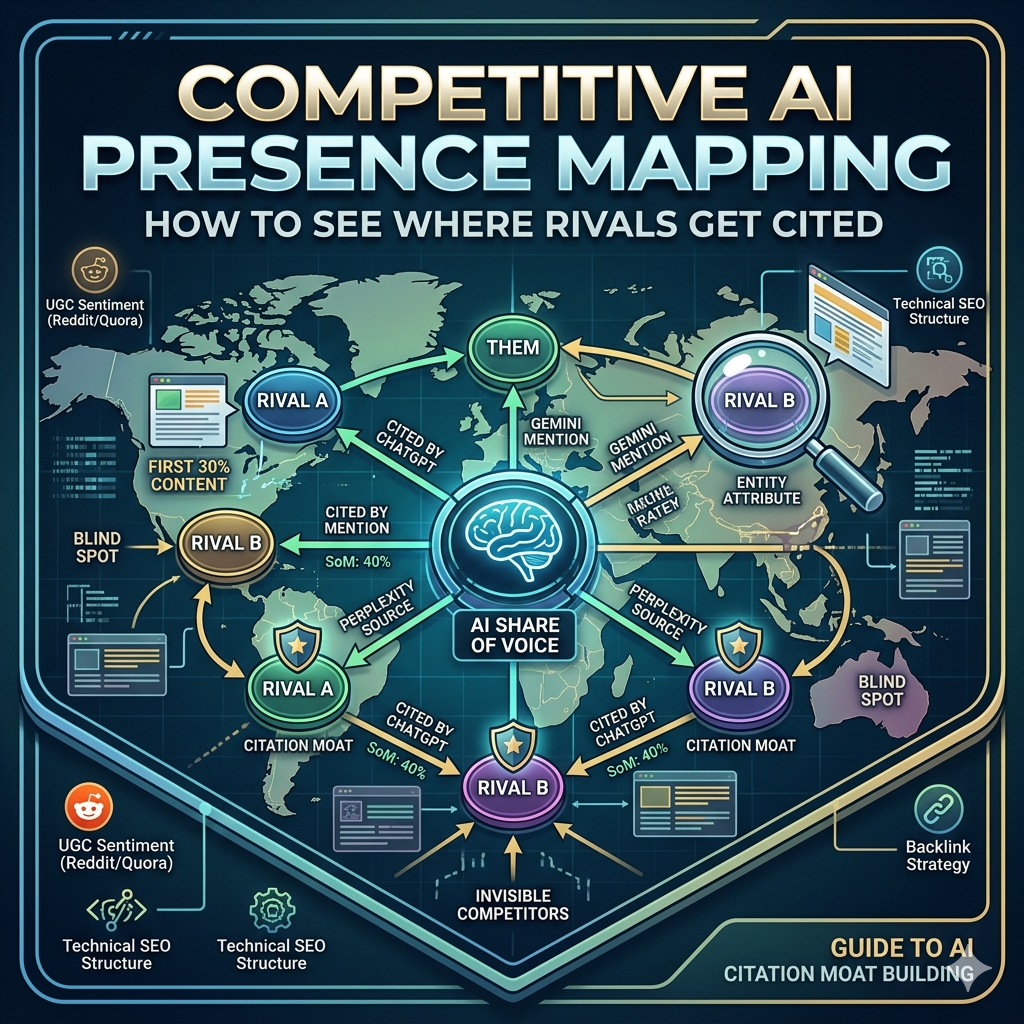
In the digital landscape of 2026, the traditional SEO leaderboard has been fundamentally disrupted. It is no longer enough to rank #1 on a Google SERP when a Generative AI Overview (AIO) or a ChatGPT response answers the user’s query before they ever scroll.
Competitive AI Presence Mapping is the process of identifying the citation moat your rivals are building. A citation moat is a strategic defensive barrier built by a brand to ensure it remains the primary source of truth for Large Language Models (LLMs). As research from The Citation Lab suggests, many brands have a competitive blind spot, which means they are losing citations to rivals they didn’t even know they had. If an AI recommends a competitor’s product or cites their blog as the definitive source of truth, you need to know why!
Here is your guide to mapping rival citations and reclaiming your AI Share of Voice.
1. Identifying the Invisible Competitors
In traditional search, you compete with other brands. In AI search, you compete with information sources. According to insights from The Citation Lab, many companies suffer from a blind spot because they only track traditional competitors.
In reality, AI models often cite neutral third parties, such as niche trade publications, regional distributors, or even specialized hobbyist blogs. If a rival is mentioned alongside these high-authority neutral sources, the AI perceives them as part of a trusted ecosystem. To map this, you must look beyond your direct sales rivals and identify which domains are providing the logic for the AI’s answer.
2. Tracking Share of Model (SoM) and Mention Frequency
By 2026, Share of Voice has evolved into Share of Model (SoM). As highlighted in Siftly’s 2026 Guide, brands must now track how often competitors appear in AI responses across ChatGPT, Gemini, Perplexity, and Google AI Overviews.
The goal is to determine the Mention Rate. The percentage of times a competitor is recommended when a user asks a category-level question (e.g., “What is the best CRM for small businesses?”). If your rival has a 40% mention rate while you have 5%, they have successfully mapped themselves into the AI’s preferred dataset. Tracking these metrics allows you to see the gap in real-time.
3. The Top-Heavy Content Audit
AI models are notoriously lazy readers. Strategic analysis of AI citations reveals a startling pattern: over 50% of citations come from the first 30% of a web page. This is what The Citation Lab refers to as the Citation Gap. We have seen similar statistics share by CXL and Medium.
If your rivals are getting cited more often, it is likely because they front-load their answers with clear, definitional statements and structured lists. AI systems prioritize clarity found in the first 150–200 words. To compete, you may need to overhaul your digital assets.
4. Analyzing Competitor Online Presence via Behavioral Trends
To map where rivals are winning, you must use modern competitive analysis techniques. According to LinkedIn’s Business Strategy insights, this involves more than just looking at a rival’s website. It requires analyzing their digital footprint across social media, forums, and customer review aggregators.
AI models use these platforms to gauge public sentiment. If a rival has a high volume of positive mentions on Reddit or LinkedIn, they are more likely to be cited by an AI as a customer favorite. Mapping where these conversations happen allows you to target those specific platforms for your own community building.
5. Leveraging AI Visibility Tools
Visibility is not just about being seen; it’s about being understood by the model. Omnia’s Knowledge Base notes that AI visibility is tied to how well a site’s technical infrastructure (like Schema markup) aligns with LLM scraping patterns.
By using tools to measure your AI Visibility Index, you can see exactly which keywords or topics your rivals own in the eyes of the AI. If a rival is cited for “sustainable manufacturing” but not for “customer service,” you have found a niche where you can potentially outshine them by optimizing your technical SEO.
6. Reverse-Engineering Citation Logic by Platform
Not all AI models cite the same way. To map rivals effectively, you must understand platform-specific logic:
ChatGPT: Favors authoritative, encyclopedic sources. As seen during our research, and observed in Profound blog too.
Perplexity: Heavily weights real-time data and community sentiment (Reddit/News).
Google Gemini: Prioritizes the Google Knowledge Graph and trusted YMYL (Your Money Your Life) sources.
If your rival is winning on Perplexity but losing on ChatGPT, it tells you their strategy is focused on “Recency” rather than “Legacy Authority.” You can read an in-depth article on how to audit your enterprise brand’s AI search visibility over here.
7. Auditing User-Generated Content (UGC) as a Citation Source
AI models like Claude and GPT-4o are increasingly trained on human-to-human interactions. As discussed in the Siftly guide, AI search results in 2026 are heavily influenced by unfiltered human opinions.
Mapping your rivals’ presence in Quora threads, Discord servers, and niche subreddits is now a requirement. If the AI thinks your rival is the leader, it’s because it read a thousand humans saying so. You must map these sentiment hubs to understand where your brand’s narrative needs reinforcement.
8. The Importance of Entity Mapping
In the world of AI, your brand is an “Entity.” LinkedIn’s competitive analysis techniques suggest that you should map which “attributes” are associated with your rival’s entity.
For example, if the AI associates “Rival A” with “cheap” and “Rival B” with “luxury,” that association comes from the specific citations the AI has processed. By mapping these associations, you can adjust your own PR and content strategy to pivot your brand entity toward more desirable attributes.
9. Strategic Backlinking and Digital PR
The mapping process often reveals that rivals are winning because of a Citation Moat, a collection of high-authority links that AI models view as foundational truths.
To bridge this gap, you need a partner who understands the intersection of traditional SEO and modern AI presence. Toss the Coin specializes in building the kind of digital authority that ensures your brand isn’t just another link, but a primary citation. Their approach focuses on creating “Entity-First” content that AI models find impossible to ignore.
10. Monitoring Citation Recency and Knowledge Cutoffs
One of the most critical parts of mapping is understanding when the AI learned about your rival. Omnia emphasizes that AI Visibility is dynamic.
A rival may have been the top-cited source six months ago, but a new knowledge update or a live-web-search feature could change that overnight. Mapping should include a “Recency Check” – are you being cited for what you did in 2023, or for what you are doing right now?
11. Statistical Reality of AI Citations
Recent data from Siftly and The Citation Lab provides a sobering look at the competitive landscape:
The 80/20 Rule: 80% of AI citations come from just 20% of the available web sources in a specific niche.
Trust Factor: Sources with verified reviews or structured academic data are 3.5x more likely to be cited as a definitive answer.
Loss of Traffic: Brands that fail to appear in AI Overviews see an average 25-40% drop in organic click-through rates.
Conclusion: Moving from Mapping to Action
Competitive AI Presence Mapping is no longer an optional extra for marketing teams. It is the foundational research of the AI era. Once the map is drawn, the next step is execution. Whether you are correcting technical visibility issues or building a new citation moat, the goal remains the same: ensure that when the AI searches for an answer, yours is the one it trusts. Toss the Coin empowers enterprise visibility in the era of AI – mediated discovery. To dominate the AI search ecosystem, we utilize the KEYSTONE 36 framework. A 3-stage systematic approach to search visibility that ensures your brand is the primary source of truth for LLMs.
Storyteller



Other posts
-



Swetha Sree Kannan
- 21 Oct 2026
- 4 min read
-

Swetha Sree Kannan
- 21 Oct 2026
- 5 min read
-


Sunil Kolakunnath
- 29 Sep 2026
- 4 min read