

Every branding discussion eventually reaches the same point.
The logo has been reviewed. The messaging has been debated. The agency has presented its recommendations. The budget has been estimated.
Then someone in the boardroom asks the inevitable question.
“What is the ROI?”
It is the right question, but I am not convinced it should be the first one.
Over the years, I have been involved in several branding and repositioning initiatives across technology companies. Some were founder-led organizations preparing for their next phase of growth. Others were established enterprises repositioning themselves around new market opportunities. In every case, the discussion around ROI was different because the reason for investing in branding was different.
That is what led me to a simple conclusion. There is no universal formula for branding ROI because there is no universal reason to invest in branding.
The first question, therefore, should not be “How do we calculate the ROI?” It should be “Why are we investing in branding?”
Once that answer is clear, the expected returns become much easier to define.
The framework below reflects my own observations from working with founder-led businesses, growth-stage companies and enterprise technology organizations. It is not intended to be an academic model, nor does it suggest that every organization follows the same path. It is simply a practical way of thinking about branding investments before attempting to measure their return.
Stage 1: Positioning for Growth
The first branding investment usually comes after an organization has discovered where it wants to compete.
The early years are often focused on building products, acquiring customers and validating the market. Branding receives the attention it deserves, but rarely becomes the organization’s highest priority. Once the business develops confidence in its positioning and begins to scale, leadership often realizes that the company’s identity no longer reflects who it has become.
The objective at this stage is not reinvention. It is alignment.
The organization uses the opportunity to sharpen its positioning, simplify its messaging and communicate its strengths more clearly to customers, partners and employees. The brand begins to reinforce growth rather than simply describe the company.
Organizations such as Postman demonstrate how branding evolves alongside business maturity. While the visual identity may change over time, the more significant transformation is often the clarity of the company’s positioning and enterprise narrative.
The expected returns are primarily commercial. Better positioning can contribute to higher quality opportunities, larger average deal sizes, stronger win rates and shorter enterprise sales cycles. Branding alone does not create these outcomes, but it strengthens the organization’s ability to achieve them.
Stage 2: Scale Readiness
Many successful technology companies grow because of exceptional delivery, strong client relationships and the credibility of their founders. Branding has not limited growth, but neither has it been expected to drive it.
As these organizations expand internationally, pursue larger enterprise clients or prepare for institutional investment, the conversation changes. The founder’s reputation must gradually become the company’s reputation.
Branding now becomes an investment in scale.
The organization begins investing in a stronger market presence through refreshed positioning, analyst engagement, leadership visibility, strategic partnerships and a more mature corporate identity. The objective is to build confidence among stakeholders who may never meet the founder but still need confidence in the organization.
This is also the stage where valuation begins to enter the discussion. Branding does not directly increase valuation. However, stronger market positioning, improved enterprise credibility, analyst recognition and predictable growth can influence the factors that investors evaluate when assigning value to a business.
The returns therefore extend beyond revenue alone. They include commercial growth, stronger market positioning and greater strategic confidence in the organization’s future.
Stage 3: Enterprise Transformation
The third stage is fundamentally different because branding is no longer the initiative. It becomes the visible expression of a broader business transformation.
This often happens when a new leadership team takes charge, private equity investment changes the company’s direction, acquisitions reshape the portfolio or the organization decides to reposition itself for the next decade.
Sometimes the catalyst is a major shift in the industry itself.
Over the past two decades, organizations have repositioned themselves around themes such as Business Process Management, Digital Transformation, Cloud Computing and, more recently, Artificial Intelligence. Some companies pioneer these shifts, while others reposition themselves to demonstrate leadership in an emerging market. In either case, the brand becomes a signal of where the organization intends to compete in the future.
Tech Mahindra’s recent brand refresh illustrates this well. The company presented its refreshed identity alongside its broader transformation strategy and AI-led direction, positioning the initiative as part of a larger strategic evolution rather than as a standalone marketing exercise.
By this stage, branding rarely exists in isolation. Organizations are simultaneously investing in new messaging, websites, demand generation, partnerships, analyst engagement, leadership visibility and sales enablement. Attempting to isolate the impact of branding from every other investment often becomes less meaningful than evaluating the overall transformation program.
Thinking Beyond ROI
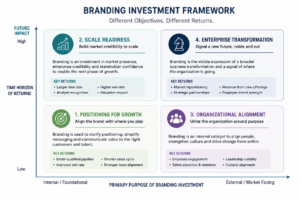
One observation has become increasingly clear to me over the years. Branding does not create only one kind of return.
It creates three.
Commercial Returns
These are the outcomes that eventually appear in business performance.
Revenue growth, pipeline quality, average deal size, win rates and shorter sales cycles are all indicators that the organization’s market positioning is supporting commercial success.
Strategic Returns
Some branding investments are approved because the organization is preparing for a future that extends well beyond the current financial year.
Improved market positioning, analyst recognition, strategic partnerships, investor confidence and valuation are strategic returns. They may not immediately appear in quarterly financial results, but they often influence the organization’s long-term trajectory.
Organizational Returns
Branding also changes how people inside the organization think about the business.
A clearer purpose, stronger employer brand, improved employee engagement and greater leadership visibility become particularly important during periods of transformation. These outcomes rarely appear on a marketing dashboard, yet they often determine how successfully an organization executes its strategy.
So, How Should CEOs Think About Branding ROI?
I do not believe there is a single formula that works for every branding initiative.
A company strengthening its positioning for growth should not evaluate branding in the same way as an enterprise repositioning itself around Artificial Intelligence. Likewise, an organization preparing for international expansion should not expect the same returns as one undertaking a broader business transformation.
Branding should therefore be evaluated against the business outcome it is intended to enable.
In some cases, the expected return will be commercial. In others, it will be strategic. Increasingly, it may also be organizational.
Where branding forms part of a broader transformation initiative, organizations may also find it more meaningful to evaluate the investment over the period during which it is expected to create value rather than comparing the entire investment against Year One outcomes. This is not an accounting treatment. It is simply a management approach that better reflects the long-term nature of branding investments.
Every branding initiative deserves an ROI discussion.
The discussion, however, should begin with purpose rather than formula.
Once leadership is clear about why it is investing in branding, the returns become far easier to define and, ultimately, much easier to measure.
Storyteller



Other posts
-



Swetha Sree Kannan
- 21 Oct 2026
- 4 min read
-

Swetha Sree Kannan
- 21 Oct 2026
- 5 min read
-


Sunil Kolakunnath
- 29 Sep 2026
- 4 min read