
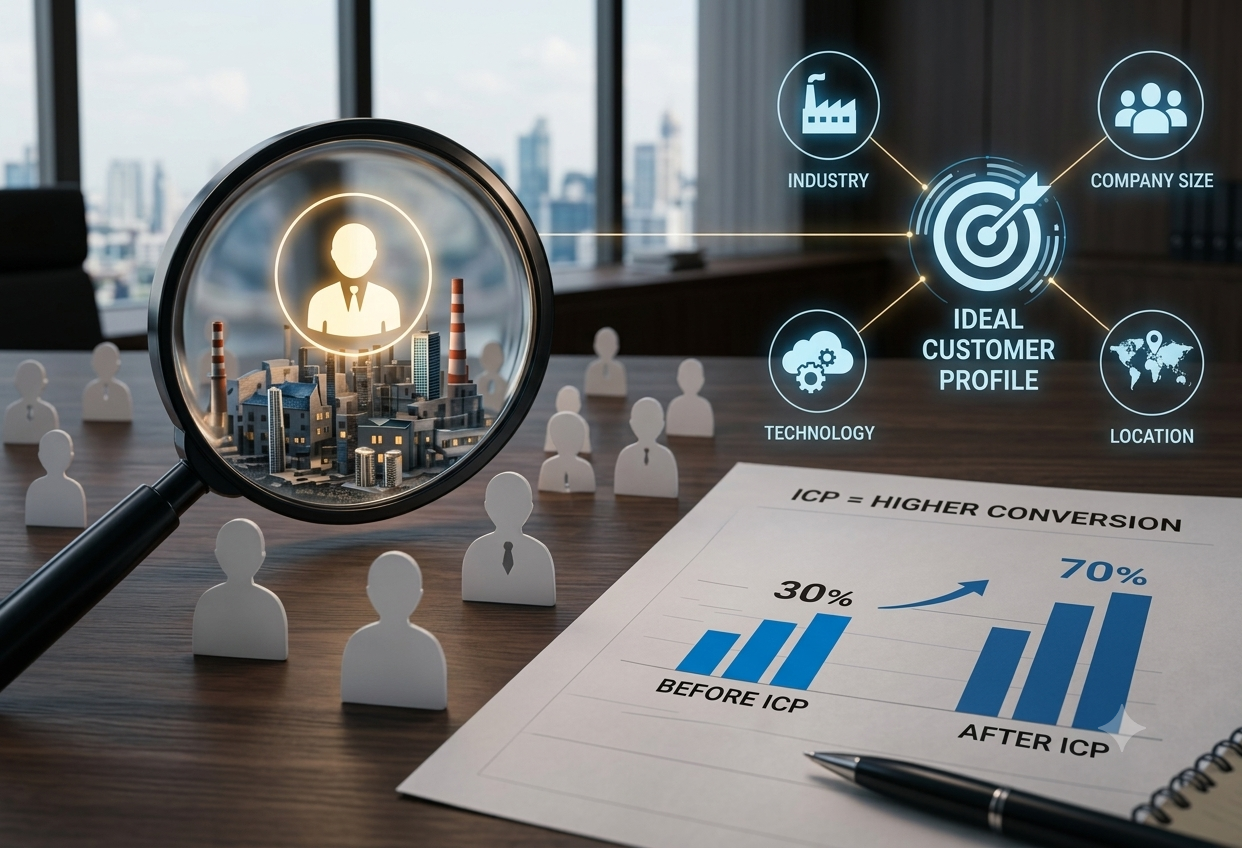
The four-dimension framework for defining, tiering, and activating Ideal Customer Profiles for Data and AI services firms.
Most go-to-market programmes fail not for lack of a large addressable market, but for lack of a rigorous way to prioritize within it. An enormous execution gap in enterprise AI adoption is a necessary starting point, but by itself it says nothing about which of the thousands of similarly sized accounts are actually likely to buy in the next two quarters. An Ideal Customer Profile is how that prioritization gets done, and it works only when it is built from evidence, not assumption.
An Ideal Customer Profile is a predictive model built from evidence: the firmographic, technographic, situational, and behavioural signals that consistently appear in accounts that convert quickly, expand reliably, and refer warmly. When an ICP is built from evidence rather than aspiration, every downstream decision becomes dramatically more efficient.
The Problem With Most ICPs
The typical IT services firm ICP reads something like: “Mid-to-large enterprise, $100M+ revenue, interested in digital transformation.” This describes a target universe of thousands of accounts, provides no basis for prioritisation, and offers no insight into what triggers buying behaviour. A usable ICP answers a very different question: who is likely to be in an active buying process within the next 90 days, and what does that account look like before they raise their hand?
“Companies with highly effective lead generation programmes are 2.2 times more likely to use data-driven buyer personas and 1.8 times more likely to score leads against a formally defined ICP built from closed-won deal analysis rather than market assumptions.”
Demand Gen Report, 2026 B2B Marketing Trends Research
The Four-Dimension ICP Framework
| Dimensions | ICP Framework |
| Firmographic | Industry vertical, revenue band, employee count, geographic presence, ownership structure. This defines the universe. Not who is ready to buy. |
| Technographic | Current data platform stack, cloud maturity, AI and ML tools licensed but under-activated. Firms with over-licensed, under-deployed AI are the highest-intent accounts in the market. |
| Situational | Trigger events that signal active need: M&A activity, new CIO or CDO appointment, failed digital transformation, audit findings, regulatory pressure, planning cycle pain. |
| Behavioral | Intent signals: content consumption on Data and AI topics, repeat service page visits, event attendance, community engagement, data engineering job postings. |
BUILD FROM EVIDENCE, NOT ASPIRATION
Run a closed-won analysis on your last 20 deals. What did winning accounts have in common across these four dimensions? What were the trigger conditions? Which stakeholder was the internal champion? That pattern is your real ICP. Identify the 50 accounts in the market that match it most closely.
The Three-Tier Account Structure
- Tier 1, Top 50 accounts: Near-perfect ICP fit, active intent signals, highest deal value. Fully personalized ABM treatment. 60% of marketing budget and senior sales time.
- Tier 2, Next 100–200 accounts: Good ICP fit, moderate intent signals. Segment-level ABM. 30% of marketing budget.
- Tier 3, Broad ICP-matched universe: Awareness stage, no active intent. Broad content marketing. 10% of marketing budget.
Five Signals That an Account Is Ready to Move Tier
- Three or more visits to service pages within a 30-day window
- Consumption of two or more substantive content pieces in a single session
- A new CIO, CDO, or VP of Data appointment announced via LinkedIn or news alert
- A relevant job posting appearing on the account’s careers page
- A third-party intent platform signal showing the account is actively researching category keywords
KEY TAKEAWAY
An ICP is a predictive model, not a description. Build it from your last 20 closed-won deals. Structure it across all four dimensions. Tier your account list into three levels and allocate your marketing budget accordingly. Review and update it every quarter using new deal data.
The framework above identifies four distinct buyer archetypes by revenue band and context. They range from large enterprise and upper mid-market to the scale-up segment and PE-backed portfolio companies. Each behaves differently, responds to different messages, and requires a different approach to reach and convert. Buying committee size, sales cycle length, and the credibility bar for competing against larger incumbents all shift substantially from one archetype to the next, and getting that distinction right is what separates a targeted go-to-market motion from a generic one.
Struggling to map your market landscape and isolate your ICP amidst all the hype? Don’t leave your pipeline to chance.
Storyteller



Other posts
-


Sunil Kolakunnath
- 29 Sep 2026
- 4 min read
-

Sunil Kolakunnath
- 25 Sep 2026
- 4 min read
-


Saloni Peeti
- 17 Sep 2026
- 4 min read