
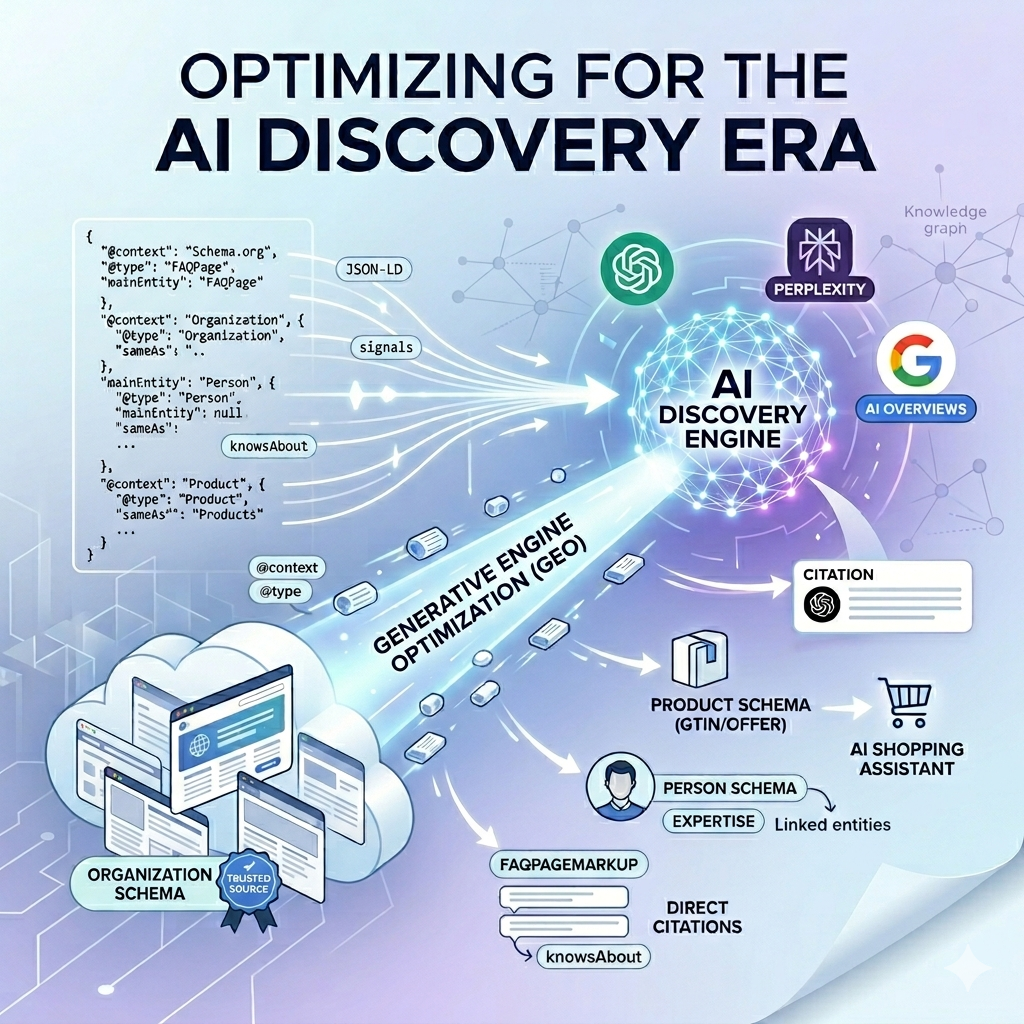
During recent time, the goal of SEO has shifted and it is now taken over by Generative Engine Optimization (GEO). It is no longer enough to rank blue links on a search page; the new objective is to become the authoritative source cited by AI models like Perplexity, ChatGPT, and Google’s AI Overviews.
The AI system does not just reads your website, it parses it for entities, facts, and relationships. Schema markup (specifically in JSON-LD format) acts as the bridge between human-readable content and machine-readable understanding.
Before mapping out your structured data, it is crucial to benchmark your current footprint; learning how to audit your enterprise brand’s AI search visibility will give you the baseline insights needed to deploy schema effectively.
Here is everything you need to know about the best Schema types for AI visibility in 2026.
1. Which Schema type is the Holy Grail for AI visibility?
While there isn’t a single silver bullet, FAQPage Schema is arguably the most powerful for direct citations.
AI engines are designed to answer questions. When you use FAQPage markup, you are essentially pre-processing your content into a format that AI can easily extract. By providing a clear Question and a concise Answer (aim for 40–60 words), you increase the probability that an AI will pull your exact text to answer a user’s prompt.
2. How does Organization Schema help with brand trust?
AI models are prone to hallucinations, confusing one brand for another or misrepresenting facts. Organization Schema (and its sister, LocalBusiness) provides the Source of Truth for your identity.
To maximize visibility:
• SameAs Property: Use this to link your website to your LinkedIn, Wikipedia, and official social profiles. This helps AI models disambiguate your brand from others with similar names.
• Logo and ContactPoint: Clearly defining these ensures that when an AI generates a brand summary, it uses your official assets and information.
3. What is Entity Linking, and which Schema supports it?
Entity linking is the process of telling an AI exactly what or who you are talking about. The Person Schema is vital here, especially for E-E-A-T (Experience, Expertise, Authoritativeness, and Trustworthiness).
By using the knowsAbout property within a Person Schema for your authors, you tell the AI: “This author is not just a writer; they are an expert in Digital Marketing and AI Ethics.” When a user asks an AI for “expert advice on marketing,” the AI looks for these specific entity connections to decide whom to cite.
4. Is Product Schema still relevant for AI shopping assistants?
It is more relevant than ever. AI agents are now performing pre-shopping research for users. If your Product Schema is incomplete, you simply won’t show up in the comparison table.
Critical 2026 Requirements:
• GTIN / MPN: Global identifiers allow AI to match your product against a global database of reviews and specs.
• Offer Schema: You must include price, priceCurrency, and availability.
• Shipping & Returns: New properties like shippingDetails and hasMerchantReturnPolicy are now being used by AI agents to rank “best value” options for users.
5. How do Article and BlogPosting Schema affect AI summaries?
When an AI summarizes a long-form article, it looks at Article Schema to understand the hierarchy of information.
• datePublished & dateModified: AI models prioritize fresh data. Ensuring these timestamps are accurate in your schema helps the AI decide if your content is still relevant.
• isBasedOn: This property allows you to cite your sources within the schema. AI models love transparency; showing that your article is based on credible data increases the likelihood of a citation.
6. Do I still need HowTo Schema?
Yes, but with a caveat. While Google deprecated some “Rich Result” displays for HowTo, AI models still use this markup to build step-by-step guides. If you want to be the voice behind a “How to soundproof a room” tutorial on a smart speaker or AI chat, HowTo Schema is the structural map those engines follow.
| Schema Type | AI Purpose | Key Properties to Include |
| FAQPage | Direct Answer Extraction | mainEntity, acceptedAnswer, text |
| Organization | Entity Disambiguation & Trust | name, logo, sameAs, contactPoint |
| Person | Authoritative Citations (E-E-A-T) | name, jobTitle, knowsAbout, sameAs |
| Product | AI Shopping Comparisons | brand, gtin13, offers, aggregateRating |
| Article | News & Informational Summaries | headline, datePublished, author, isBasedOn |
| Review | Sentiment Analysis & Validation | reviewRating, author, publisher |
Advanced Strategies for Generative Engine Optimization (GEO)
The Move to JSON-LD
In 2026, JSON-LD is the undisputed king. It is a script-based format that sits in theof your HTML. Unlike older formats like Microdata, JSON-LD is completely decoupled from your visual design. This makes it cleaner for AI crawlers to parse without getting lost in your CSS or JavaScript.
Schema-Content Mismatch
The quickest way to lose AI visibility is to have your Schema say one thing while your page says another. If your Product Schema lists a price of $99, but your page says $120, an AI model will flag your site as unreliable. In the era of AI, consistency is authority.
Using “About” and “Mentions”
Within your WebPage or Article schema, you can use the about and mentions properties to explicitly list the entities discussed.
• About: The primary subject (e.g., “Generative AI”).
• Mentions: Secondary subjects (e.g., “Large Language Models,” “Google SGE”).
This helps AI models categorize your content into the correct Knowledge Graph nodes.
Common Myths About Schema and AI
Myth 1: Schema guarantees an AI citation.
• Reality: Schema is a signal, not a guarantee. It increases your extractability. Think of it as making your content high-definition for the AI’s eyes. If the content itself is low quality, no amount of schema will save it.
Myth 2: More schema is always better.
• Reality: Schema stuffing (adding irrelevant markup) can lead to penalties. Only mark up what is actually visible on the page. AI models are trained to detect mismatches.
Myth 3: AI doesn’t need schema because it’s smart.
• Reality: While AI is smart, it is also computationally expensive. Schema provides a shortcut for the AI to understand your site’s data without having to use massive amounts of processing power to guess. AI engines prefer the path of least resistance.
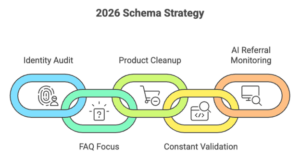
Summary Checklist for 2026
1. Audit your Identity: Ensure Organization and Person schemas are fully populated with sameAs links to external authorities.
2. Focus on FAQs: Identify the top 5–10 questions your audience asks and wrap them in FAQPage markup.
3. Clean up Products: Ensure every product has a GTIN and real-time Offer data.
4. Validate Constantly: Use tools like the Schema Markup Validator and Google’s Rich Results Test to ensure your code is error-free.
5. Monitor AI Referrals: Track how much traffic is coming from “Generative” sources (like chatgpt.com or perplexity.ai) to see which schema types are driving the most value.
By structuring your data today, you are not just optimizing for a search engine. You are building the foundation for how the world’s most advanced artificial intelligences will perceive and recommend your brand. For brands adapting to this environment, partnering with a specialized B2B marketing agency like Toss the Coin can help implement these technical frameworks smoothly.
Storyteller



Other posts
-



Swetha Sree Kannan
- 21 Oct 2026
- 4 min read
-

Swetha Sree Kannan
- 21 Oct 2026
- 5 min read
-


Sunil Kolakunnath
- 29 Sep 2026
- 4 min read