
The corporate world has officially moved past the era of AI experimentation. As we cross into the second quarter of 2026, the narrative has shifted from whether a company uses Artificial Intelligence to how effectively that AI translates into market dominance.
According to the latest Gartner projections, worldwide AI spending is expected to total $2.52 trillion in 2026, a massive 44% increase year-over-year. Yet, a sobering report from McKinsey reveals a persistent friction point: only 39% of enterprises are seeing a significant, measurable impact on their bottom line.
The culprit is rarely the underlying model or the technical infrastructure. Instead, the failure lies in the Visibility Gap.
In a world where Large Language Models (LLMs), Search Generative Experiences (SGE), and specialized agents act as the primary filters for information, being on the internet is no longer enough. You must be in the model. To navigate this, strategists are turning to a new mission-critical tool: The Enterprise AI Visibility Scorecard.
Understanding the New Search Triad
To understand why visibility must be measured differently in 2026, we have to look at the collapse of the traditional blue link monopoly. We are now operating within the Search Triad:
- SEO (Search Engine Optimization): Traditional keyword-based ranking.
- AEO (Answer Engine Optimization): Structuring data so that “answer engines” like Perplexity or Gemini can provide direct, concise responses.
- GEO (Generative Engine Optimization): Influencing the narrative and creative output of LLMs to ensure your brand is cited as the preferred solution.
The Scorecard is the bridge between these three worlds. It quantifies how a brand’s intellectual property is ingested, understood, and ultimately recommended by AI.
“2025 was a year of purposeful digital transformation where the conversation shifted from mere expansion to agile performance. As we look to 2026, the industry will double down on building secure, scalable, and intelligent digital foundations.” — Global Tech Leadership Council, 2026
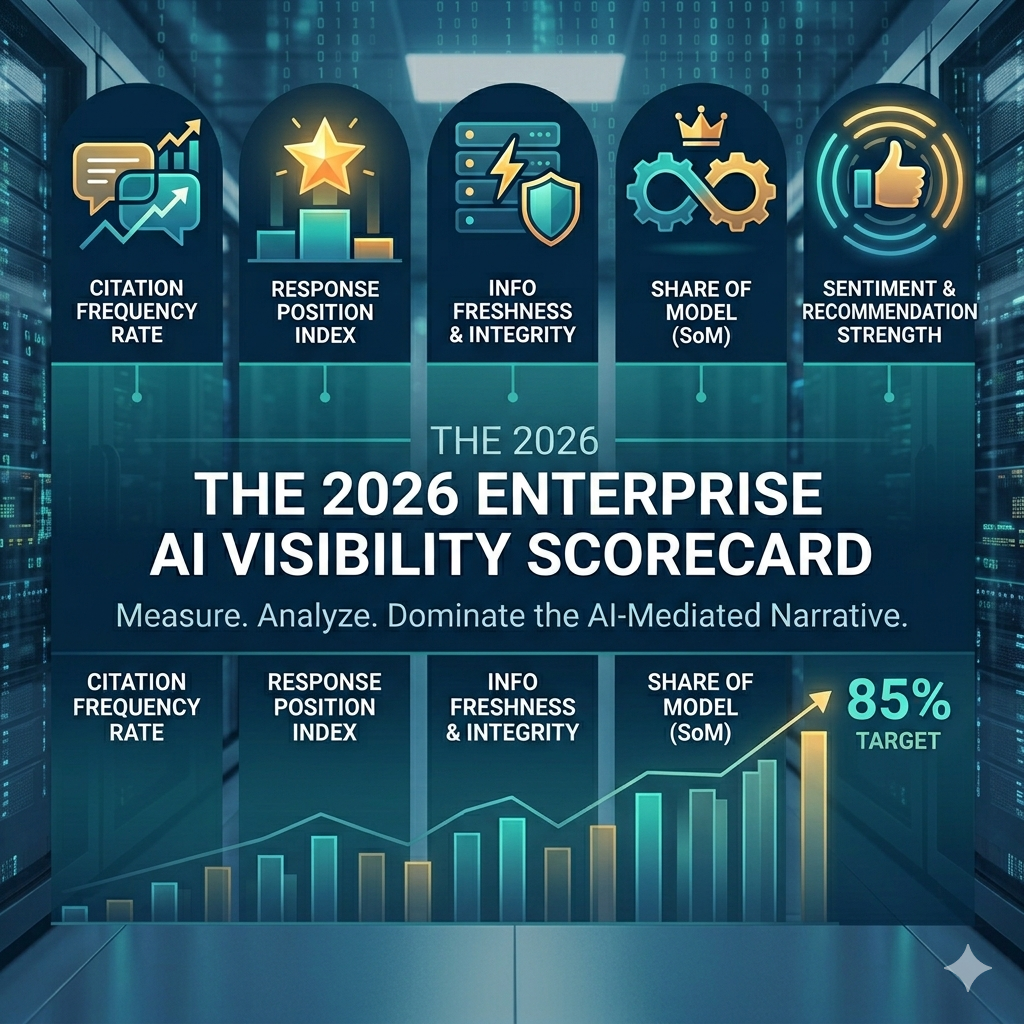
The 5 Pillars of the AI Visibility Scorecard
A robust scorecard doesn’t just track mentions; it tracks the quality of influence. Here is the deep dive into the five core pillars that define AI visibility today.
1. Citation Frequency Rate (CFR)
CFR is the new “Click-Through Rate.” It measures how often your brand, whitepaper, or product is cited as a source across a set of 1,000 industry-relevant prompts.
- The Benchmark: For Tier-1 enterprises, a CFR of 15–30% is considered healthy.
- The Risk: If your CFR is high but your Source Authority is low (meaning AI is citing third-party reviews of you rather than your own documentation), you lose control of the narrative.
2. Response Position Index (RPI)
In generative search, Position Zero is no longer enough. You need to be the Primary Recommendation.
- Primary: Your brand is the main subject of the answer.
- Secondary: Your brand is listed among 3–5 peers.
- Tertiary: Your brand is mentioned in a footnote or “see also” section.
The RPI calculates the weighted average of these positions to determine your “narrative weight.”
3. Information Freshness & Integrity Score
AI models often suffer from knowledge cutoff or stale data hallucinations. This pillar audits whether the AI is citing your 2026 pricing and product features or hallucinating data from a 2022 blog post.
In 2026, research shows that 64% of enterprise-related hallucinations stem from conflicting data found in outdated PDFs and archived web pages.
4. Share of Model (SoM) vs. Share of Voice
Traditional Share of Voice (SoV) measures your presence in media. Share of Model (SoM) measures your presence in the latent space of the LLM.
If a user asks an AI, “What is the most reliable B2B marketing agency for tech startups?”, and your brand isn’t in the top three results, your SoM is effectively zero for that high-intent query.
5. Sentiment & Recommendation Strength
Visibility is a double-edged sword. An AI could mention your brand frequently but warn users about known implementation hurdles. This pillar uses sentiment analysis to score the intent of the AI’s recommendation ranging from Skeptical/Neutral to Highly Recommended.
Why Visibility is the New ROI
In the current landscape, the Discovery Gap is widening.
- The 6% Club: Only 6% of AI High Performers are seeing a 5% or larger boost to their EBIT. These leaders are not just using AI to write emails; they are using it to optimize their external digital footprint.
- The Citation Disconnect: Recent studies indicate that 80% of LLM citations do not rank in Google’s top 100. This means if your strategy is purely SEO-focused, you are invisible to the 3% of the global population now using GenAI as their primary discovery tool.
“Success is becoming visible. We can now see what it looks like to use AI to build a leading-edge operating or business model. The disciplined march to value begins.” — PwC 2026 AI Business Predictions
The Human-in-the-Loop Governance
While the Scorecard is a technical tool, its success relies on a concept often overlooked: The Taste Gap. As AI-generated content floods the internet, the Signal-to-Noise ratio has plummeted. Models are increasingly being trained on AI-generated data, leading to a model collapse where creativity and nuance are lost. This is where Human-in-the-Loop (HITL) governance becomes a competitive advantage.
Enterprises that maintain a high Visibility Score are those that inject human taste, intentionality, and unique proprietary data into their digital ecosystem. The AI isn’t just looking for data; it’s looking for authoritative, high-quality human insight to anchor its responses.
Free Template: The Enterprise AI Visibility Scorecard (Monthly Audit)
Use this framework to conduct a monthly audit of your brand’s performance across major LLMs (OpenAI, Anthropic, Google, and Perplexity).
| Category | Metric | Goal / Benchmark | Weight | Current Score |
| Presence | Citation Frequency (CFR) | > 25% | 25% | |
| Prominence | Response Position Index | Top 2 Mention | 20% | |
| Trust | Source Authority (Owned vs. 3rd Party) | >60% Owned | 15% | |
| Accuracy | Fact Integrity Score | 100% (No Hallucinations) | 25% | |
| Sentiment | Recommendation Strength | > 4.5/5 Positive | 15% | |
| TOTAL | AI Visibility Index | Target: 85%+ | 100% |
Implementation Steps:
- Define 50 Core Queries: These should be the high-intent questions your customers ask when they are ready to buy.
- Test Across Models: Run these queries through at least three different LLM architectures.
- Identify Leakage: Look for instances where the AI cites a competitor for a feature you
- Optimize the Source: Update your technical documentation, schema markup, and About pages to provide the AI with clearer, more structured hooks.
Bridging the Gap Between Intelligence and Influence
In the corporate environment, we frequently emphasize the importance of achieving clarity and focus amidst the fast-paced nature of modern business. The AI Visibility Scorecard acts as a stabilizing framework within this landscape. It provides the objective data necessary to move away from speculation and transition toward evidence-based measurement.
As the landscape continues to shift toward autonomous agents and generative discovery, the enterprises that win won’t just be the ones with the biggest budgets. They will be the ones that understand the mechanics of influence in an AI-mediated world.
To dive deeper into the technical nuances of the Search Triad and how to bridge the Taste Gap in your marketing strategy, explore our full library of insights at the Toss the Coin Thought Leadership Hub.
Recommended Reading for 2026 Strategy:
- The Search Triad: Mastering the interplay between SEO, AEO, and GEO.
- Human-in-the-Loop: Why “Taste” is the final moat for modern brands.
- Share of Model: The new metric for B2B authority.
- From Chatbots to Agents: How visibility changes when AI starts taking actions.
Storyteller



Other posts
-



Swetha Sree Kannan
- 21 Oct 2026
- 4 min read
-

Swetha Sree Kannan
- 21 Oct 2026
- 5 min read
-


Sunil Kolakunnath
- 29 Sep 2026
- 4 min read