
Why Your “GEO Agency” Might Just Be Selling You Old SEO in a New Packaging
In exactly twelve months or maybe even sooner, the technical barriers to marketing will effectively hit zero.
Imagine sitting at your desk, opening a dashboard, and clicking a single button. By the time you’ve finished your first cup of coffee, AI has drafted 50 high-quality blog posts. It has built an optimized, high-converting landing page from scratch. It has analyzed millions of search trends to set up paid campaigns targeting the exact keywords your customers are typing. It has even drafted personalized emails based on thousands of individual data points.
If AI tools can do all that for the price of a monthly subscription, it raises a terrifying question for the industry: What happens to the agencies that charge thousands of dollars to do those exact things?
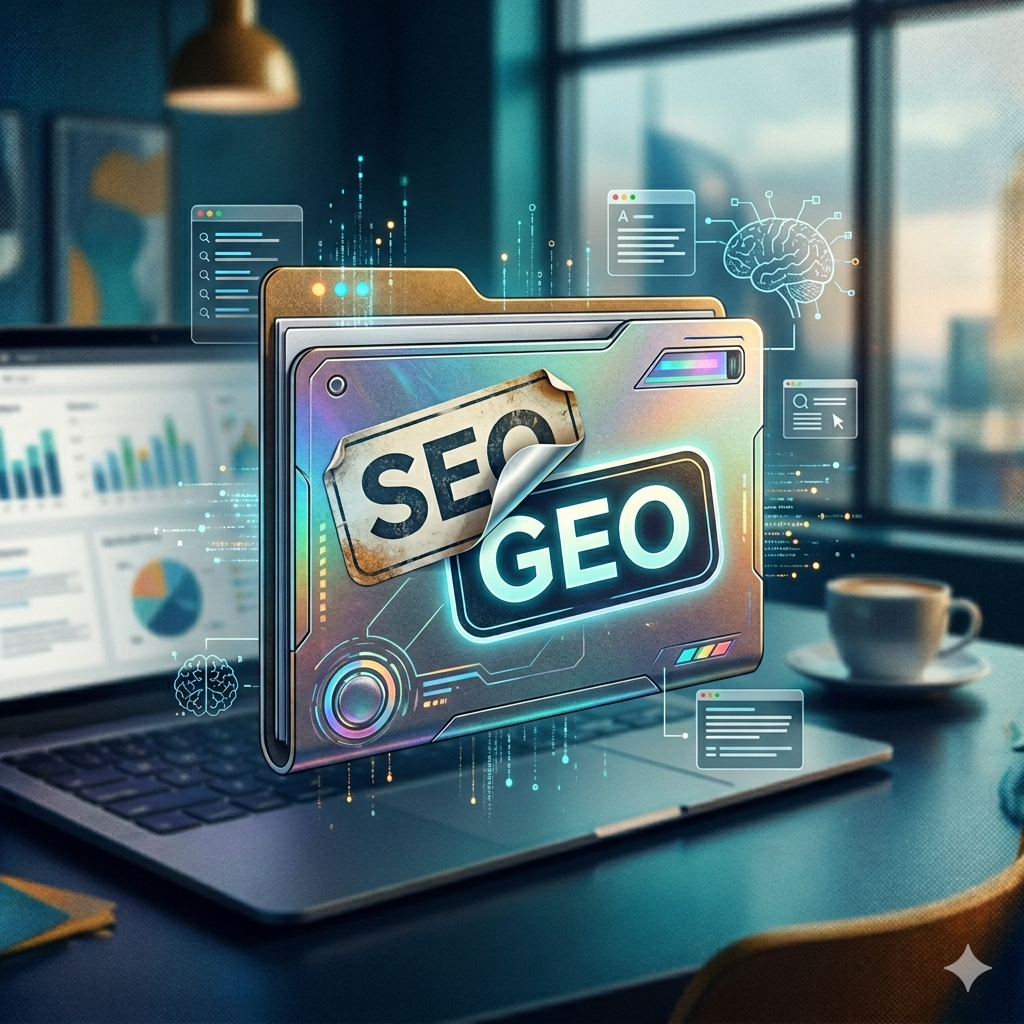
The marketing world is currently in a state of frantic evolution. If you look at LinkedIn today, everyone is suddenly an expert in GEO (Generative Engine Optimization). But here’s the secret: a huge portion of them have simply taken their 2019 SEO checklist, put on a “GEO” sticker on the folder, and hoped no one would notice the difference.
I have had multiple conversations this month with business owners who were pitched “GEO packages.” When they asked, “What actually makes this different from the SEO you sold me last year?” the answers were… blurry.
The truth is, GEO isn’t a single product you can buy off a shelf. It’s a shifting target. And if your agency can’t explain the why behind their strategy, they Haven’t understood the fundamentals of GEO.
The Skill Was Never in the “Doing”
After a decade in the search industry, a fundamental truth has emerged: The value of an agency was never really in “doing the work.” Writing words, tweaking code, and setting up ads are tactical commodities.
The real skill has always been knowing which work to do.
As we move into an AI-driven search landscape where Google’s SGE (Search Generative Experience) and Perplexity AI provide direct answers instead of a list of links the “work” changes for every single client. At agencies like Toss the Coin, the shift isn’t just about using AI tools; it’s about identifying which lever to pull when the old playbook stops working.
To understand why a “one-size-fits-all” GEO package is a red flag, let’s look at three different scenarios.
Scenario 1: The Invisible Authority
Problem: You have a world-class website. Your technical SEO is flawless. Your content is written by experts. But when someone asks a chatbot, “Who are the best consultants for manufacturing efficiency?” your name never comes up.
Reality: AI models like Gemini or Claude don’t just crawl your site; they look for the social proof across the entire web. This proof AI tools attain from Reddit or LinkedIn or other major industry publications and high-authority news sites.
GEO Approach: This client doesn’t need more blog posts. They need Digital PR and Expert Outreach. They need to be mentioned in the places that AI models use as training data. This is about building a brand footprint that forces the AI to recognize you as an authority.
Scenario 2: The Technical Ghost
Problem: This company has been featured in Forbes. They have a great reputation. But when you search for their specific services, the AI-generated summary at the top of the page pulls data from their competitors instead.
Reality: The technicalities of the website is broken. While humans can read the site fine, the AI crawlers are getting lost.
GEO Approach: This is where Schema Markup and Site Architecture become the heroes. As highlighted in Toss the Coin’s AI-SEO strategies, you have to structure your data so clearly that an AI can digest it in milliseconds. If your “About Us” page doesn’t explicitly tell the LLM (Large Language Model) who you are and what you do in a machine-readable format, you’re leaving your visibility to chance.
Scenario 3: The Reputation Crisis
Problem: The website is fast. The PR is decent. But the reviews are a mess. Customer perception has been sliding for two years due to a botched product launch or poor support.
Reality: Generative engines are becoming sentiment-aware. If the consensus across the web is that your service is “laggy” or your “support is unresponsive,” the AI tools will literally tell the user: “Company X is popular, but many users report issues with their customer service.”
GEO Approach: No amount of keyword research fixes a bad reputation. The strategy here shifts to Sentiment Management. It involves identifying the sources of negative sentiment and systematically addressing them while encouraging “positive signals” from satisfied customers.
The “Toss the Coin” Philosophy
If your agency tells you they have a “GEO Tool” that fixes everything, run.
Real GEO is about understanding the AI Search Lifecycle. At Toss the Coin, the focus isn’t just on getting a link on page one; it’s about influencing the answer the AI provides.
Think about how you use ChatGPT or Perplexity. You don’t want a list of ten websites; you want the answer to your problem. If your business isn’t part of that answer, your traffic will vanish.
What Modern GEO Actually Looks Like
Let’s break down what an agency should actually be doing if they claim to be “AI-ready”:
- Contextual Content Mapping: Instead of writing for “keywords,” we write for “intent.” We ask: What specific problem is the user trying to solve, and how can we provide the most comprehensive answer that an AI would want to summarize?
- Entity Building: In the eyes of an AI, your brand is an “entity.” We work to connect your brand entity to other high-value entities (like industry leaders, specific technologies, or locations).
- Data-Backed Personalization: Using tools to analyze thousands of data points just like the scenario we opened with to ensure that the emails and landing pages we build actually resonate with the human on the other side.
The Human Element in an AI World
If AI can do the drafting, the coding, and the targeting, what is left for the humans?
Strategy. Empathy. Context.
An AI can write a blog post about “The Benefits of Cloud Computing,” but it can’t sit in a boardroom with you, understand your specific revenue goals for Q4, and realize that your biggest hurdle isn’t “awareness”, it’s a specific technical glitch on your checkout page that’s killing conversions.
The agencies that survive the next 12 months won’t be the ones with the best prompts. They will be the ones who act as Business Partners.
At Toss the Coin, the goal is to use AI to remove the “grunt work” so we can spend more time on the “brain work.” We use AI to analyze the data so we can spend our time figuring out why the data looks the way it does.
If you’re currently looking for a partner to help you navigate this new world, ask them these three questions:
- “How does your strategy change for a Perplexity user vs. a Google user?” (If they say it’s the same, they don’t understand GEO).
- “Which specific ‘entities’ are you trying to associate my brand with?” (This tests their understanding of how LLMs categorize information).
- “Can you show me how you’re using Schema to influence AI summaries?” (This tests their technical depth).
If they start stuttering or give you a generic answer about “high-quality content,” you’re looking at a repackaged SEO package.
The Bottom Line
The next year will be the most disruptive period in the history of digital marketing. Don’t see the AI one-click future as a threat, we can convert it into a strength. It means we can finally stop obsessing over word counts and meta-descriptions and start focusing on Brand Authority.
The skill was never in doing the work. It was in knowing what work to do.
Whether you are looking at Toss the Coin’s innovative approaches or building your own in-house team, remember this: The AI sphere is the engine, but you still need a driver who knows exactly where you’re trying to go.
The landing pages will be live soon. The 50 blog posts will be written in seconds. The question is: Will they actually say something worth reading?
That’s where we come in.
Storyteller



Other posts
-



Swetha Sree Kannan
- 21 Oct 2026
- 4 min read
-

Swetha Sree Kannan
- 21 Oct 2026
- 5 min read
-


Sunil Kolakunnath
- 29 Sep 2026
- 4 min read