23 Jun 2026
The Integration Tax: Why Your Optimizely Investment Is Under-Delivering, and Who’s Actually Responsible

Most DXP failures are not platform failures. They are accountability failures. Here is what that costs you, and what the structural fix looks like.
In 2025, Optimizely ended Adobe’s five-year run at the top of the Gartner Magic Quadrant for Digital Experience Platforms, positioning highest on both axes. Native A/B testing, multivariate experimentation, and feature flags ship with the platform by default — capabilities that most competitors either bolt on as an afterthought or license from a third party entirely. For most organizations evaluating a DXP investment, the analyst community has, for all practical purposes, already made the platform decision on their behalf.
Which makes the next question an uncomfortable one. If the platform is this good, why is yours still under-delivering?
The answer is almost never the technology. It is the model around it. And if you are the person sitting between your engineering team and your marketing function — translating, coordinating, absorbing every delay — you already know this intuitively. You feel it in every escalation, every re-scoped ticket, and every quarter that passes without meaningful experimentation actually running. What you may not have named yet is what this experience actually is. It is an integration tax. You are paying it every single day, and the way most Optimizely engagements are structured, you will keep paying it indefinitely.
What the integration tax actually is
The integration tax is not a budget line item. It is the accumulated cost of a broken accountability model that the DXP industry built into its standard delivery structure decades ago and has never had a strong enough incentive to fix.
Here is how it plays out in practice. An engineering vendor delivers your Optimizely build. They are skilled, they are certified, and they execute the project well. The platform goes live, the statement of work closes, and they move on to the next engagement. Your marketing agency, meanwhile, has ambitious ideas for personalization and experimentation — the exact capabilities Optimizely was purchased to enable. They are also skilled. But they do not speak DXP, and they cannot make changes to the platform without routing requests back through the engineering team. So every campaign requirement becomes a ticket. Every ticket joins a queue. Every queue introduces a delay, and the delays compound.
The result is a three-party engagement where no single vendor owns what the platform actually delivers. The engineering firm built it and moved on. The marketing agency wants to use it but cannot get close enough to move fast. And you, the person who understands both sides well enough to translate between them, end up absorbing the full cost of a gap that nobody designed but everybody accepts. That is the integration tax, and it does not shrink over time. It compounds.
What it actually costs
Vague frustration does not make a business case for changing the model, so it is worth being specific about the three costs the integration tax actually produces.
Platform waste. Optimizely’s experimentation capability is native, not bolted on, which means A/B testing, multivariate experiments, and feature flags are available the moment your engineers build correctly against the platform. The overwhelming majority of organizations running Optimizely are not running meaningful experimentation at any reasonable cadence, and the reason is rarely a lack of interest. It is that the coordination overhead between marketing intent and engineering execution makes it structurally impossible to move fast enough to build a real test-and-learn culture. The license earns far less than it should.
Cycle drag. Work that should take weeks ends up taking quarters, and the culprit is rarely an underperforming individual. It is the natural output of a delivery model where every change requires a handoff across vendor boundaries, a translation layer between marketing and engineering, and a re-scoping conversation that resets the clock each time. The platform was designed for speed. The model wrapped around it was not.
Strategic drift. Your actual mandate is to turn Optimizely’s experimentation and personalization capabilities into measurable business outcomes: pipeline growth, conversion improvement, revenue impact. The integration tax does not simply slow that down. It consumes the time and attention the mandate requires in the first place. You end up spending your days managing vendor handoffs instead of building the digital program your organization invested in Optimizely to achieve.
Why the obvious fixes do not work
Two moves tend to look sensible in this situation, and neither one resolves the underlying structural problem.
The first is bringing in a systems integrator to sit above the vendor landscape and manage delivery coordination. This adds a party to the engagement rather than removing one. You now have a coordination layer managing a coordination problem, and the integration tax simply relocates one level up the chain, with a new invoice attached to it.
The second is asking your marketing agency to go deeper on Optimizely. Some agencies try this, and the intention is genuine. But a marketing agency is not a certified Optimizely engineering partner, and it was not built to maintain a production-grade .NET stack, manage platform upgrades, or own complex third-party integrations. Asking them to do so introduces a different category of risk, one that tends to surface at the worst possible moment in a campaign cycle.
The problem is not the people in any of these roles. It is the model itself. The integration tax is a structural problem, and structural problems require structural solutions. Specifically, they require removing the seam entirely rather than managing it more carefully.
The structural fix: one team, from blueprint to drive
The BUILDx framework was designed to answer a single question: what does a genuinely accountable engagement look like when it holds engineering depth and experience management under the same roof, from the first strategic conversation through to continuous optimization?
Five stages, one framework, and an AI layer running through every stage by construction rather than as an afterthought.
Blueprint. Technology strategy and brand strategy are planned together in the same room, by the same team. One blueprint, signed by both the engineering and experience leads, so that the technical decisions and the experience decisions are made concurrently rather than sequentially. The reconciliation cost that typically accumulates during a handoff simply does not occur.
User Experience. Designers and engineers co-author the UX from the very beginning of the engagement. This is not a handoff from design to engineering once wireframes are approved. Both disciplines are present for both conversations, which means the gap between what a designer intends and what an engineer can actually build closes before it becomes a problem.
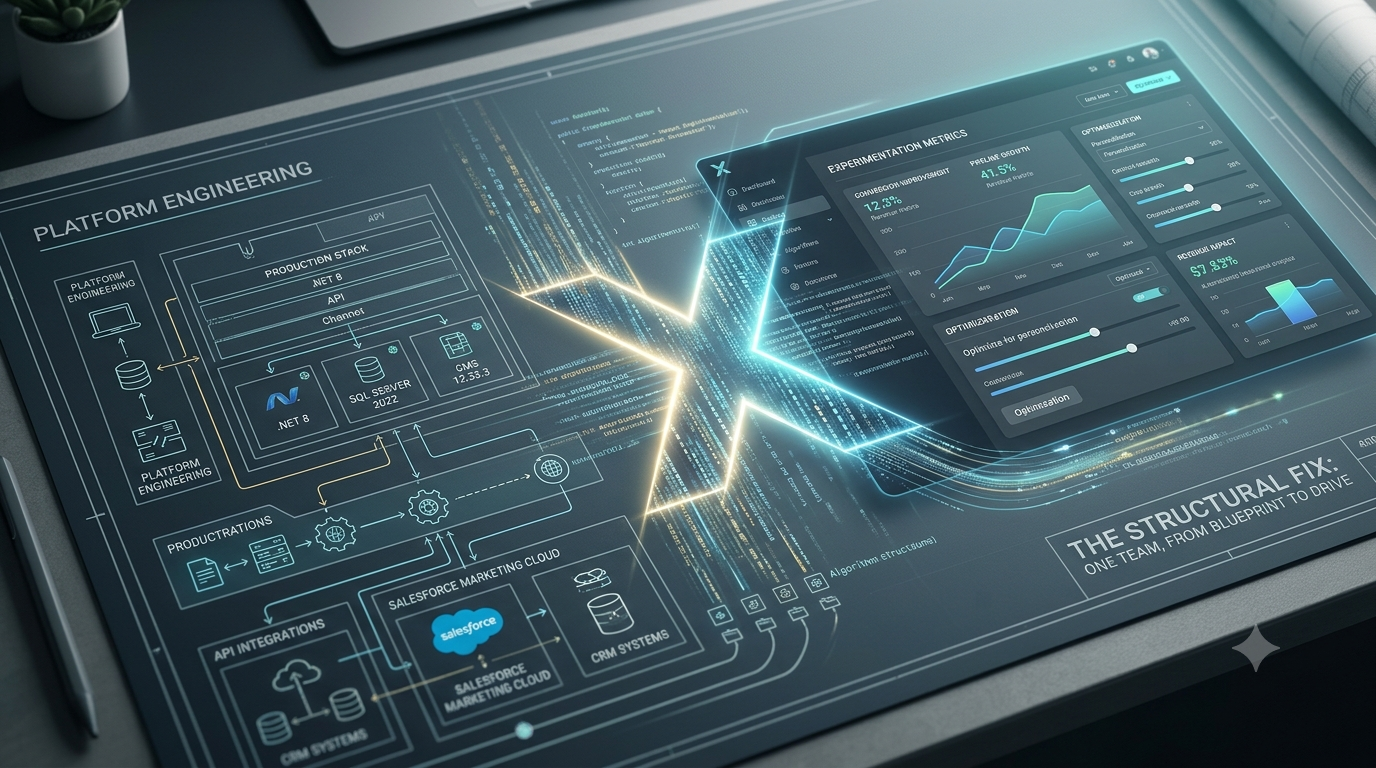
Infrastructure. Optimizely platform engineering and AI-native delivery are built on a production-grade stack: CMS 12.33.3, .NET 8, SQL Server 2022, with engineers who are current on the latest releases rather than maintaining legacy codebases. Live integrations with Salesforce Marketing Cloud and modern CRM systems are built and maintained by the same team, not theorized in a discovery document and handed off to someone else.
Launch. The team that built the platform takes it to market. There is no handoff from engineering to marketing at go-live, because the engineering team and the marketing team were never separate to begin with.
Drive. Continuous optimization against real business outcomes: pipeline, conversion, and revenue. Not tickets closed, not platform uptime, not features shipped. This is where the integration tax normally swallows the mandate whole. With one accountable team holding the full engagement, it is where the mandate actually gets delivered.
The X in BUILDx is the AI layer. It is not a sixth stage added at the end of the process, and it is not a feature bolted on once the build is complete. It is embedded into every stage by construction.
Six things that change
When Optimizely runs through the Center of Excellence, six things change in a way that is structural rather than incremental.
To begin with, you get more of the platform you already paid for. The license finally earns its keep because experimentation and personalization are no longer stranded behind a coordination queue waiting for an engineering ticket to clear. Beyond that, the engagement is AI-native by default, with the X layer running through every stage of BUILDx, which means you are not scrambling to catch up to AI as a capability in 2027. You are operating with it from day one.
From a vendor standpoint, you are dealing with fewer parties and less coordination overhead. One statement of work, one team accountable for the outcome, and one point of contact when something needs to change. On the delivery side, speed returns without translation loss. Cycles that currently run in quarters compress to weeks because the translation layer between marketing intent and engineering execution no longer exists.
The model is also B2B-native rather than B2C retrofitted, which means it was built for long sales cycles and multi-stakeholder buying environments rather than adapted from a consumer model and applied to enterprise. And perhaps most importantly, the engagement is measured on outcomes the CFO will actually recognize: pipeline, conversion, and revenue, rather than the delivery metrics that tend to fill status reports but never appear in a board conversation.
The question worth asking now
Gartner has already answered the platform question. Optimizely is where the enterprise DXP market is heading, and the analyst data on both its capability lead and its cost advantage over legacy alternatives makes that case clearly. The question worth asking now is whether the model around your investment is actually built to realize it.
If you are still carrying the integration tax — still translating between engineering and marketing, still watching quarters pass without meaningful experimentation, still managing vendor coordination instead of building your digital program — the answer is that it is not. And that is not a technology problem. It is a structural one, and a structural fix is available.
The Optimizely Center of Excellence is a joint practice from AES, the certified Optimizely Solution Partner, amplified by Toss the Coin’s award-winning B2B brand and GTM expertise. Engineering, experience, and AI for digital experience, under a single accountable engagement across APAC.
If you want to understand what removing the integration tax looks like in practice for your organization, start a conversation with the CoE team. Not a brief, not a scope document. Just a conversation.
Storyteller



Other posts
-



Swetha Sree Kannan
- 21 Oct 2026
- 4 min read
-

Swetha Sree Kannan
- 21 Oct 2026
- 5 min read
-


Sunil Kolakunnath
- 29 Sep 2026
- 4 min read