
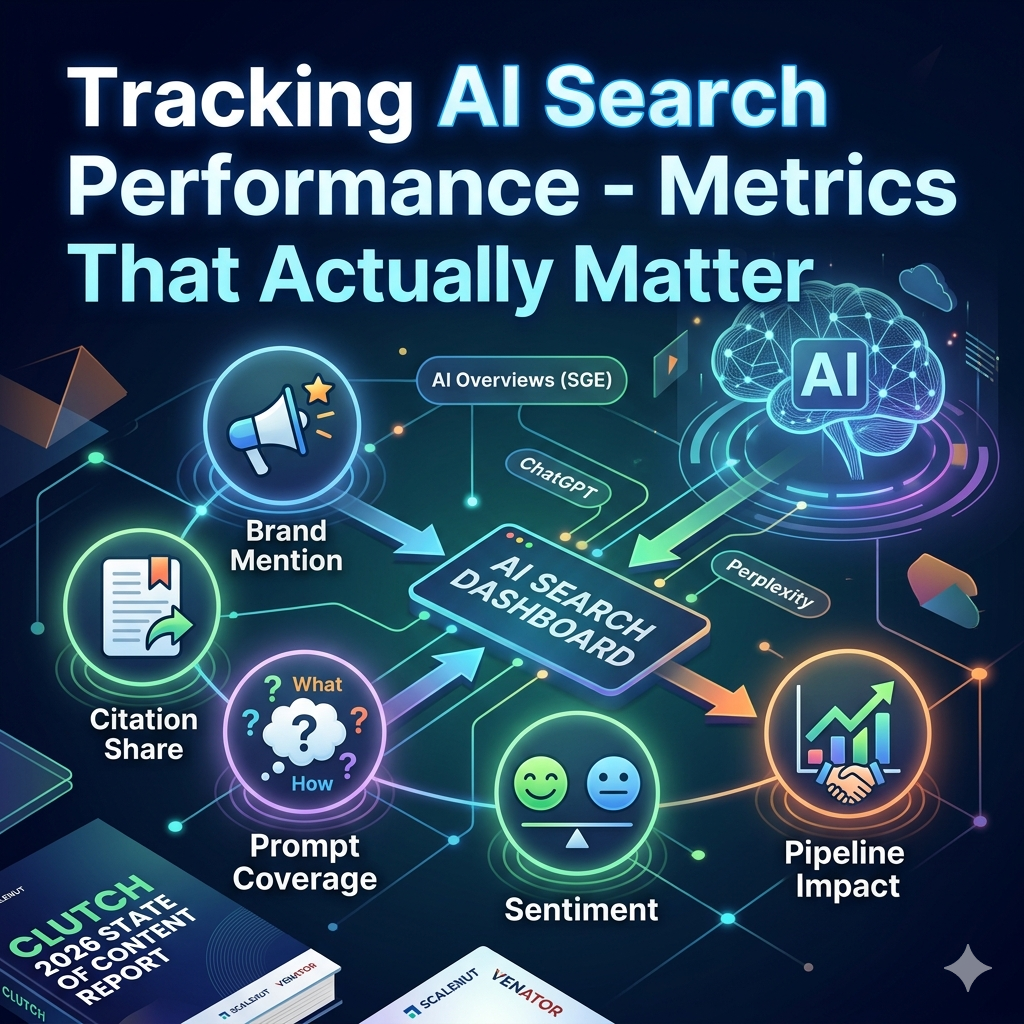
The traditional landscape of search is undergoing a seismic shift. As Google’s AI Overviews (SGE), ChatGPT, and Perplexity become the primary interfaces for information discovery, the old playbooks and the metrics that fueled them are being rewritten.
To explore what success looks like in this new era, we sat down with a panel of experts to discuss the key performance indicators (KPIs) that actually matter for AI search performance.
The Interview: Redefining Visibility in the AI Era
Moderator: For years, SEO was defined by blue links and ranking #1. Today, users might never even see a link; they see an AI-generated summary. How does this change the way we measure performance?
Shakti Prasad: It is a complete pivot from traffic-first to answer-first. In the past, we measured how many people clicked. Now, we have to measure how much of the conversation we actually own within the AI’s response. According to Scalenut, one of the most vital metrics today is the Brand Mention Rate. This tracks how often your company’s name appears in AI search results, even without a direct link. If an AI tells a user, “Tools like [Your Brand] are best for this task,” you’ve influenced the user long before they ever visit your site. This is unlinked brand equity, and it’s a powerful indicator of visibility that traditional analytics often miss.
Moderator: That sounds like a shift toward brand awareness. But how do we track the authority of our content if the AI is the one speaking?
Expert Panelist: That’s where the AI Citation Rate comes in. As noted by Yogesh Rathore on LinkedIn, your citation rate measures how frequently AI platforms reference your content as a source. If your citation rate is climbing, it means AI models recognize your website as an authoritative, factual source. It’s the new version of the clicks, but with a much higher stakes: the AI is essentially vouching for your data to the user.
Moderator: We’ve heard a lot about Share of Voice. Does that still apply when there are no pages of results to scroll through?
Shakti Prasad: It’s more critical than ever. Scalenut highlights Share of Voice (SOV) in AI Answers as a competitive benchmark. AI Share of Voice is the percentage of relevant AI-engine visibility your brand owns compared to your competitors across a defined set of user prompts. Traditional SEO allowed brands to hide behind technical optimizations like schema markup and page speed to rank well. In contrast, AI Share of Voice forces a return to true digital PR and holistic authority. Establishing the AI Share of Voice Benchmark has been explained in detail in whitepaper how to audit your enterprise brand’s AI search visibility. To track this, you identify high-value queries for your niche and see how often your brand is cited versus your competitors. If a user asks for the “best marketing automation for SMBs,” and the AI mentions your competitor 80% of the time, your SOV is dangerously low. Monitoring this over time tells you if your content strategy is actually moving the needle in the AI’s training set or real-time retrieval
Moderator: Let’s talk about Zero-Click searches. If the AI answers the question and the user leaves, hasn’t the marketer lost?
Expert Panelist: Not necessarily. Venator Performance Marketing (citing Forbes Agency Council insights) argues that we need to look at Zero-Click Traffic Influence. AI summaries might reduce immediate clicks, but they build brand trust and familiarity. The metric here isn’t the click; it’s the conversions later in the funnel. You might see a dip in organic referral traffic but a spike in direct traffic or branded search as users, having seen you in an AI summary later search for you by name.
For years, digital marketing fell into the trap of optimizing for algorithms rather than humans—chasing clicks, page views, and session durations because those were the easiest boxes to check on a report.
Zero-click AI search forces us to break that addiction to intermediary vanity metrics. If your content is genuinely authoritative, unique, and deeply helpful, the AI will use it as its foundation. And when the AI trusts your brand enough to tell a buyer you have the answer, the click will eventually find its way to you.
Madison Logic reinforces this by focusing on Account Engagement and Pipeline Impact. In the B2B world, it’s about whether that AI visibility is moving in-market accounts closer to a deal. As James Hickey writes for Madison Logic, 45% of marketing leaders now see AI-powered search as a key trend for brand validation. Success is measured by how that exposure accelerates deal velocity, not just how many people landed on a blog post.
Moderator: What about the technical side of things? If we want to be featured in these AI summaries, what metrics should we be watching on our own sites?
Expert Panelist: You have to look at Prompt Coverage. Scalenut defines this as how well your content library addresses the specific, conversational questions users are asking. AI search isn’t about keywords; it’s about intents. If your content only targets “best coffee beans” but doesn’t answer “how to store coffee beans for maximum freshness in a humid climate,” you’re missing prompt coverage.
Additionally, Venator suggests tracking Content Readability and Structure. AI prefers clear, structured, Q&A-formatted content. If your readability scores are low, or your structured data (Schema) is messy, AI agents will struggle to scrape and understand your site. Joost de Valk (Joost.blog) notes that modern search is vectorized engines convert content into mathematical representations. If your content isn’t clearly optimized for topics over keyphrases, you won’t rank in that vector space.
Moderator: There is a lot of talk about LLMs as the new audience. A recent Clutch report mentioned that a quarter of marketers are now writing specifically for AI models. What metrics support that strategy?
Shakti Prasad: The Clutch 2026 State of Content Report found that 75% of marketers have expanded AI use in their workflows, and many now identify LLMs as a first-class audience. A key metric here is AI Visibility Score. This is a holistic look at how often AI systems pull from your site across platforms like ChatGPT, Gemini, and Claude.
Clutch also highlights that Video and Original Research are becoming the currency of AI visibility. Why? Because LLMs are increasingly training on transcripts and proprietary data. Tracking the extractability of your content, how often your original data points are quoted by AI is a vital new KPI for enterprise-level teams.
Moderator: If we sum it up, what are the Big Four or Big Six metrics our readers should put on their dashboard tomorrow?
Expert Panelist: Based on the consensus from Forbes, O8 Agency, and Medium, here is the essential dashboard for 2026:
- AI Visibility/Mention Rate: How often does the AI say your name?
- Citation Share: Are you the footnoted source for the answer?
- Prompt Coverage: Do you have content for the long-tail, conversational questions?
- Sentiment in AI Responses: When the AI mentions you, is it in a positive, neutral, or nega\tive context?
- Zero-Click Influence: Tracking the correlation between AI mentions and later direct-site traffic.
- Account-Based Engagement (for B2B): Is AI visibility leading to higher-quality leads or faster pipeline growth?
Conclusion
The era of AI search doesn’t mean the end of measurement; it means the end of lazy measurement. We can no longer rely on a single organic traffic line in Google Analytics to tell us if we are winning.
Success in 2026 and beyond requires a multi-dimensional approach:
- Qualitative: Is the AI representing our brand accurately?
- Quantitative: How many citations and mentions are we earning?
- Outcome-Based: Is this visibility resulting in brand trust and, eventually, revenue?
As Mike Beares, CEO of Clutch, puts it: “Original, trustworthy content is becoming the currency of visibility.” If you can measure that currency, you can master the AI search era.
Storyteller



Other posts
-

Swetha Sree Kannan
- 21 Oct 2026
- 4 min read
-

Swetha Sree Kannan
- 21 Oct 2026
- 5 min read
-


Sunil Kolakunnath
- 29 Sep 2026
- 4 min read